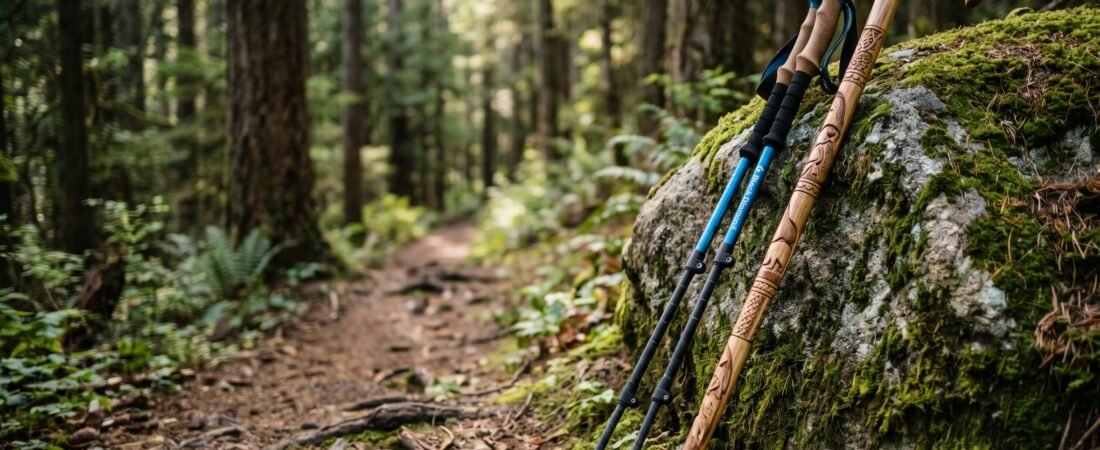
Walk into any outfitter or scroll through hiking gear forums and you’ll quickly run into a friendly debate: trekking poles or a hiking stick? Both have earned their place on the trail, and the truth is that experienced hikers often own and use both, reaching for whichever tool fits the terrain in front of them. Understanding what each one does best will help you make a smarter choice for your own adventures.
What Is a Hiking Stick Best For?
A traditional walking or hiking stick shines on flatter, more forgiving terrain. It won’t take a dramatic amount of weight off your back the way a pair of poles will, but it does deliver real benefits where it counts. A good stick helps stabilize your stride, takes some pressure off your knees, and gives you a reassuring point of contact with the ground on uneven footing.
There’s also something a hiking stick offers that no high-tech pole can match: character. Many sticks become deeply personal objects. A friend might strip the bark, finish it with shellac, and carve a design into the top. Hikers often collect medallions from national parks and memorable trailheads, fastening them to the shaft until the stick becomes a running record of where they’ve been. Some sticks arrive engraved with your name or a bit of laser-cut artwork; others are gifted half-finished, ready for you to complete yourself. A few clever designs even hide useful features, like a hollow in the handle sized to hold a glow stick for low-light walking. Whether you carry it on the trail or display it proudly at home, a hiking stick tends to carry stories along with you.
Why Do So Many Hikers Prefer Trekking Poles?
For longer, tougher, or more variable outings, trekking poles often win out. Plenty of hikers come to poles almost by accident, picking up a set bundled with snowshoes and discovering they make a noticeable difference. Once you feel how much they help, it’s hard to go back.
The biggest advantage shows up when you’re backpacking under a heavy load. A pair of poles relieves tension across your back, eases strain on your knees, and adds meaningful stability over rough ground. They’re remarkably intuitive too. You simply walk with your natural gait and let your hands follow the rhythm; within minutes the motion feels automatic.
What Features Should You Look For in Trekking Poles?
A few details separate good poles from great ones. Consider the following when choosing your first pair:
- Comfortable grips. Dense foam handles feel great and stay cool, while cork grips gradually mold to your fingers and become a personal fit over time.
- Supportive straps. Sliding your hands up into the straps and pulling down relieves grip fatigue and lets you push from the wrist rather than clenching the handle all day.
- Adjustable length. Look for poles with upper and lower adjustments. Aim for roughly a 90-degree bend at your elbow when the tip touches the ground, and fine-tune from there.
- Swappable baskets. Small baskets near the tip add stability in snow or mud and pop on and off as conditions change.
- Reliable locking mechanisms. Lever or screw-style locks let you set your length and trust it to stay put.
A Couple of Pro Tips
On a long downhill stretch, extend your poles about five to ten centimeters. The extra length keeps your hands at a natural height as the ground falls away, giving you steadier footing on the descent.
Serious backpackers will appreciate another bonus: many ultralight tents are designed to use trekking poles as their support structure. That means the poles you already carry pull double duty at camp, saving the weight of dedicated tent poles.
The Bottom Line
You don’t necessarily have to choose just one. A hiking stick is a wonderful, personal companion for relaxed walks on gentler ground, while trekking poles are the workhorses for heavy packs, steep grades, and changing conditions. Match the tool to the terrain, and your knees, back, and overall stability will thank you mile after mile.